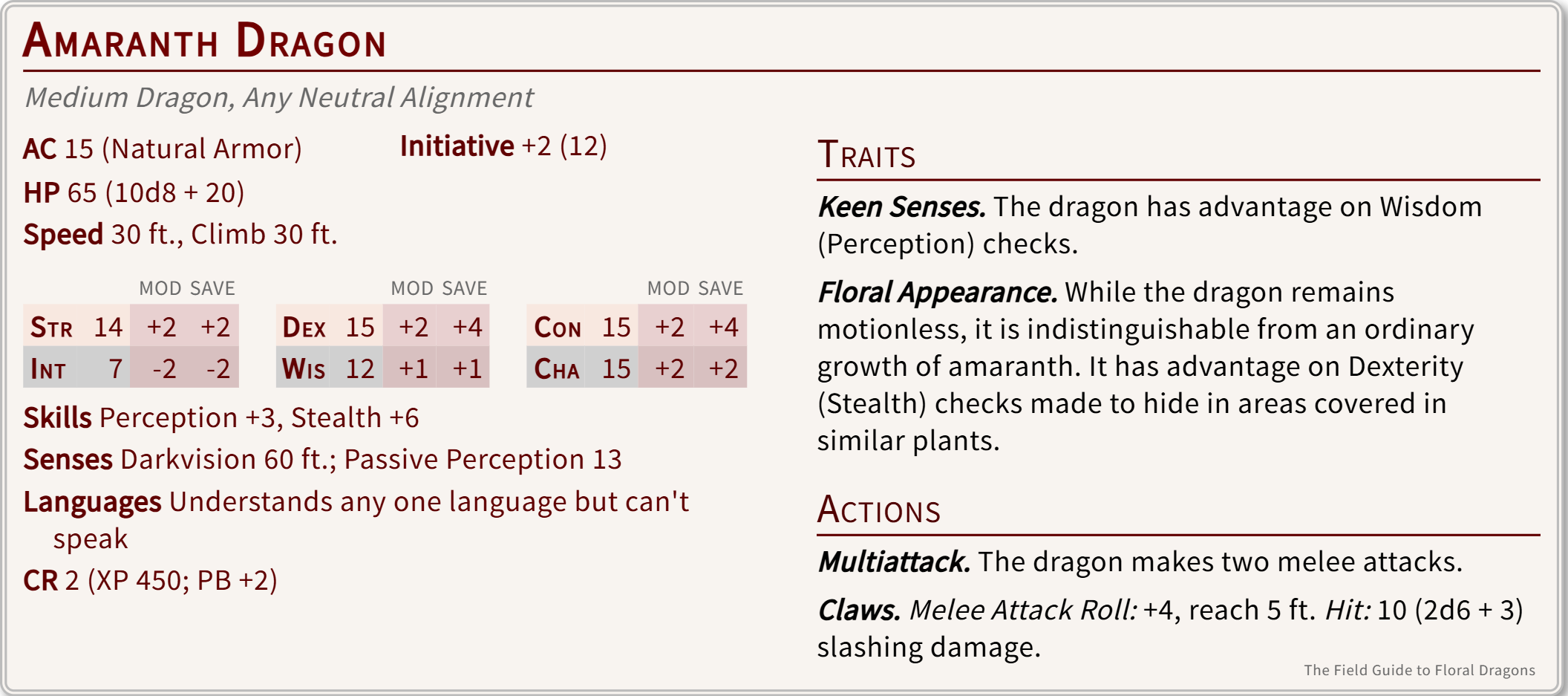
Hit Point Press
Amina
Amaranth dragons are lively companions and excellent trackers
How the Amaranth Dragon Became a Friend
The amaranth dragons were once immortal, or so stories say. Their flowers never faded, and their leaves never withered. However, they were not invulnerable. Early humanoids hunted amaranth dragons to test the truth of their immortality, trying various cruel methods to kill the dragons. When these hunters inevitably failed, they gave up and abandoned the dragons to a slow recovery.
One such hunter, Juan, felt remorse for their cruelty and took in an amaranth dragon they had grievously injured. They renounced hunting, nursed the dragon back to health, and gained its trust. Juan and the dragon became close companions, with the amaranth dragon acting as a scout and tracker for the former hunter.
Juan and the dragon adventured together for many years until Juan was too weak and frail to continue. The amaranth dragon realized that its friend was dying and that it would outlive every other humanoid friend it made. Grief-stricken, the amaranth dragon assembled its kin in a great congregation, the likes of which have never been seen again. Juan’s dragon explained the joy of a deep connection and the pain of losing Juan. After hearing out the lamenting dragon, the dragons came to a consensus. They would ask the gods for two things—an end to their immortality and a lasting friendship between amaranth dragons and humanoids.
The god of compassion heard the dragons’ prayers and granted their wish: the amaranth dragons would be companions to humanoids and would no longer outlive their friends.
Juan’s amaranth dragon died peacefully. Since then, amaranth dragons have lived out the rest of their now-mortal lives as friends to humanoids.
Physiology
Caption
Fig. 1 An amaranth dragon climbs a tree.
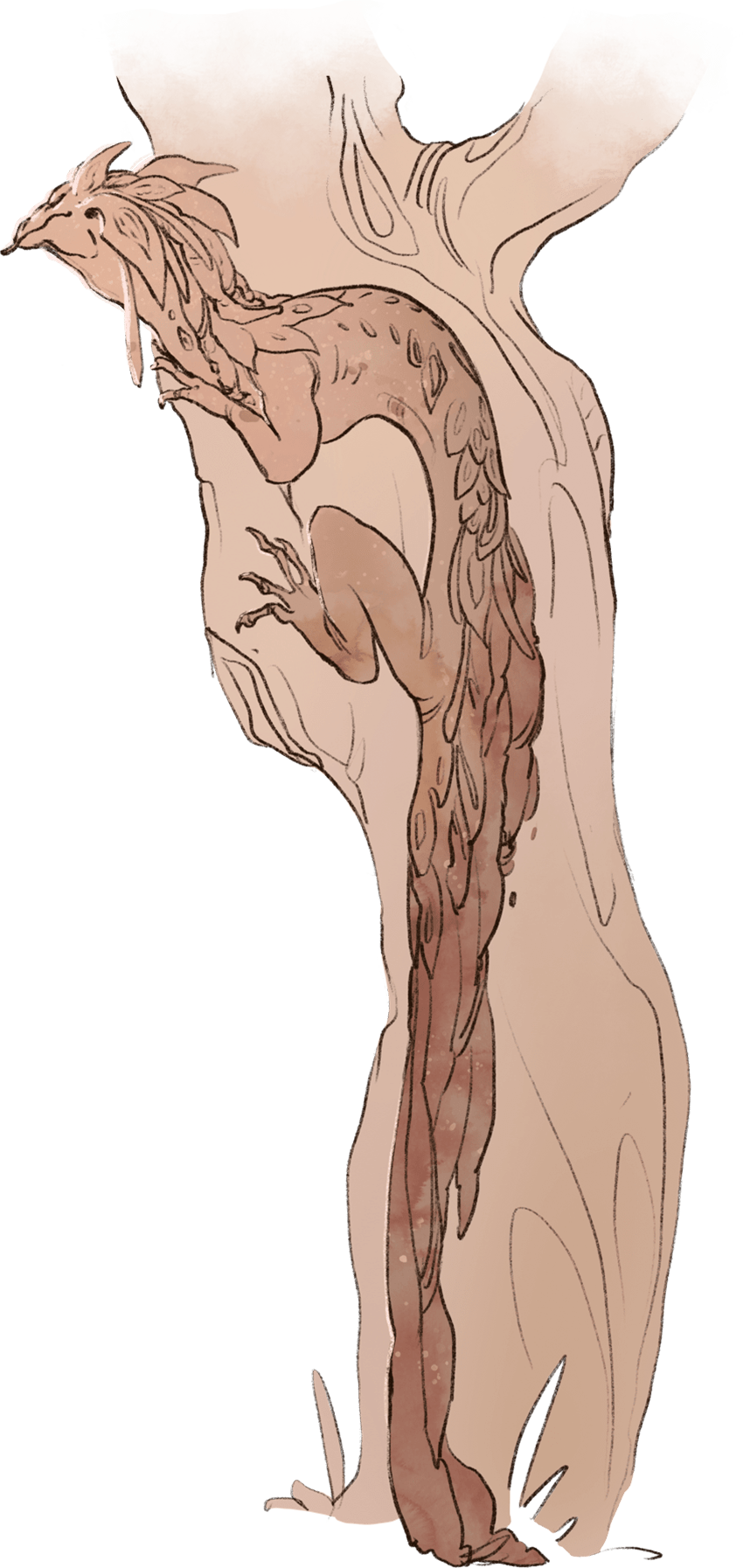
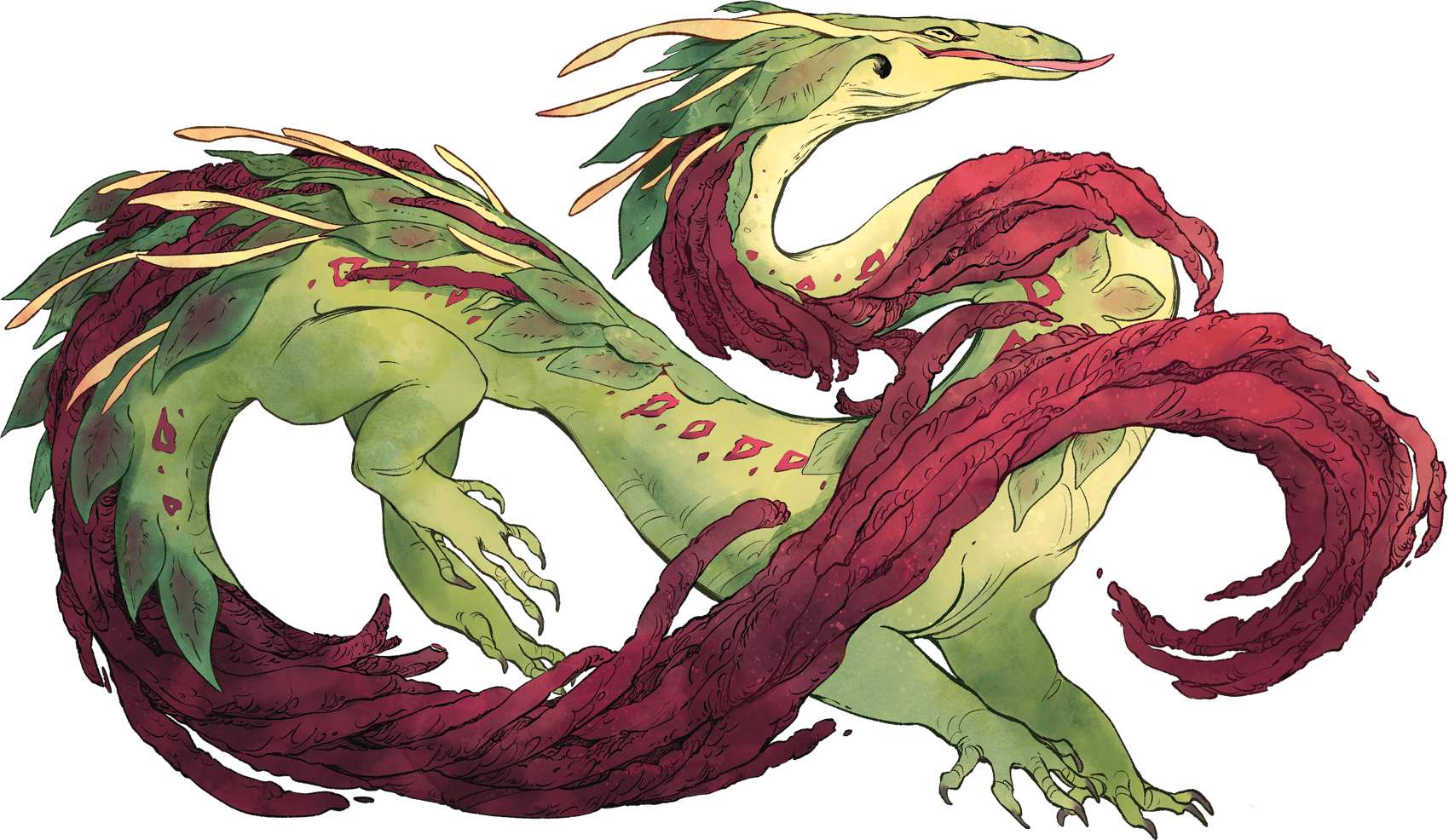
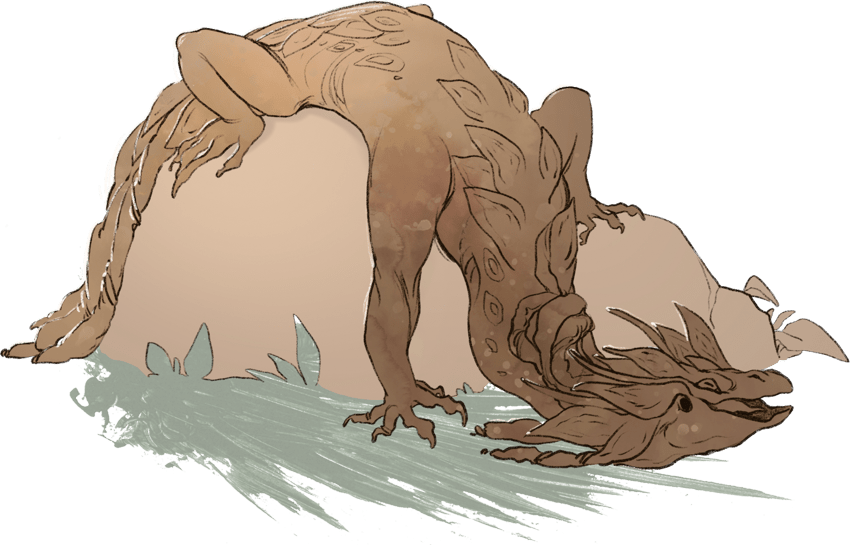
Amaranth dragons can grow up to six feet in length, not including their tails, which can be as long as their bodies. Today, they live for around 80 years, with the oldest recorded amaranth dragon living to the age of 83. Their flowers bloom most commonly in red, but shades of lighter pink and reddish purples are also possible. Despite their bright red flowers, amaranth dragons have excellent camouflage and hide in plain sight. They can stay very still, blending in with their environment. Wanderers often believe that the dragons’ flowery tails are simply amaranth plants growing in the wild. Amaranth dragons have strong, root-like claws that allow them to secure themselves to trees. They boast excellent vision, even at night.
Akin to iguanas shedding their skins, amaranth dragons shed their leaves and flowers before growing new ones. The frequency with which they shed gradually decreases as they age; young amaranth dragons shed roughly once every twenty-eight days, and a mature, undomesticated, amaranth dragon sheds once a year in the spring. The discarded leaves are edible, as are the amaranth seeds the dragons produce.
Habitat
Amaranth dragons can be found most commonly in jungles, but a few have been known to reside in temperate forests. Environments with rich, well-draining soil and plenty of sunlight are ideal for these tree-dwelling dragons. If they don’t get enough sunlight or water, their leaves and flowers will wither and potentially die before they are due to shed. The dragons make their nests in high tree canopies using twigs and their own discarded leaves.
In forests, amaranth dragons can often be found alongside magnolia dragons. The magnolia dragon drops seeds and fruit from its tail that the amaranth dragon eats. Under the watchful protection of these significantly larger dragons, the amaranth dragons have a safe place to nest.
Thanks to their friendly and playful natures, amaranth dragons frequently live with humanoids. The dragons are especially helpful as companions when tracking because of their excellent vision and ability to camouflage themselves.
Amina
I saw a glorious plume of amaranth on a tree, so I stopped to take a look. As I followed the direction of its growth, I saw a stem thicker than any I’d ever seen before and four large, well, if I didn’t know better, I’d call them “appendages.”
Only when I saw its eyes did I realize it wasn’t a plant; it was a creature, and it was blinking at me! I wonder what it is and if it can be tamed…
Behavior
Amaranth dragons typically feed on fruit and seeds native to the area in which they live. Since they require so much sunlight, wild amaranth dragons hibernate in hollow trees during cold seasons, emerging in early spring to reenter the world.
Each dragon mates with a new partner during each mating season. To select a mate, a female amaranth dragon climbs up a tree as fast as she can, after which all her suitors race to the top. She then jumps from tree to tree as the competitors pursue her. Female amaranth dragons have greater stamina than males. Males who cannot keep up with the female drop out of the race, and the female mates with the male left standing at the end. Eggs are laid in clutches of two or three at a time, and the male leaves before they hatch five to seven days later.
The female amaranth dragon cares for her young until they flower, at which point she pushes her offspring from the nest, and they must climb back up the tree on their own. If the young dragon fails to climb back up, most mothers choose to help their offspring, but there are some who leave them to their fate. When a young amaranth dragon has learned to build its own nest, it is ready to live independently and leaves its mother.
Wild amaranth dragons are more likely to run and hide than to fight. They are not territorial and will rebuild a nest in a new tree without much trouble. They rely on their camouflage to conceal themselves, only using their claws in the face of a relentless attacker.
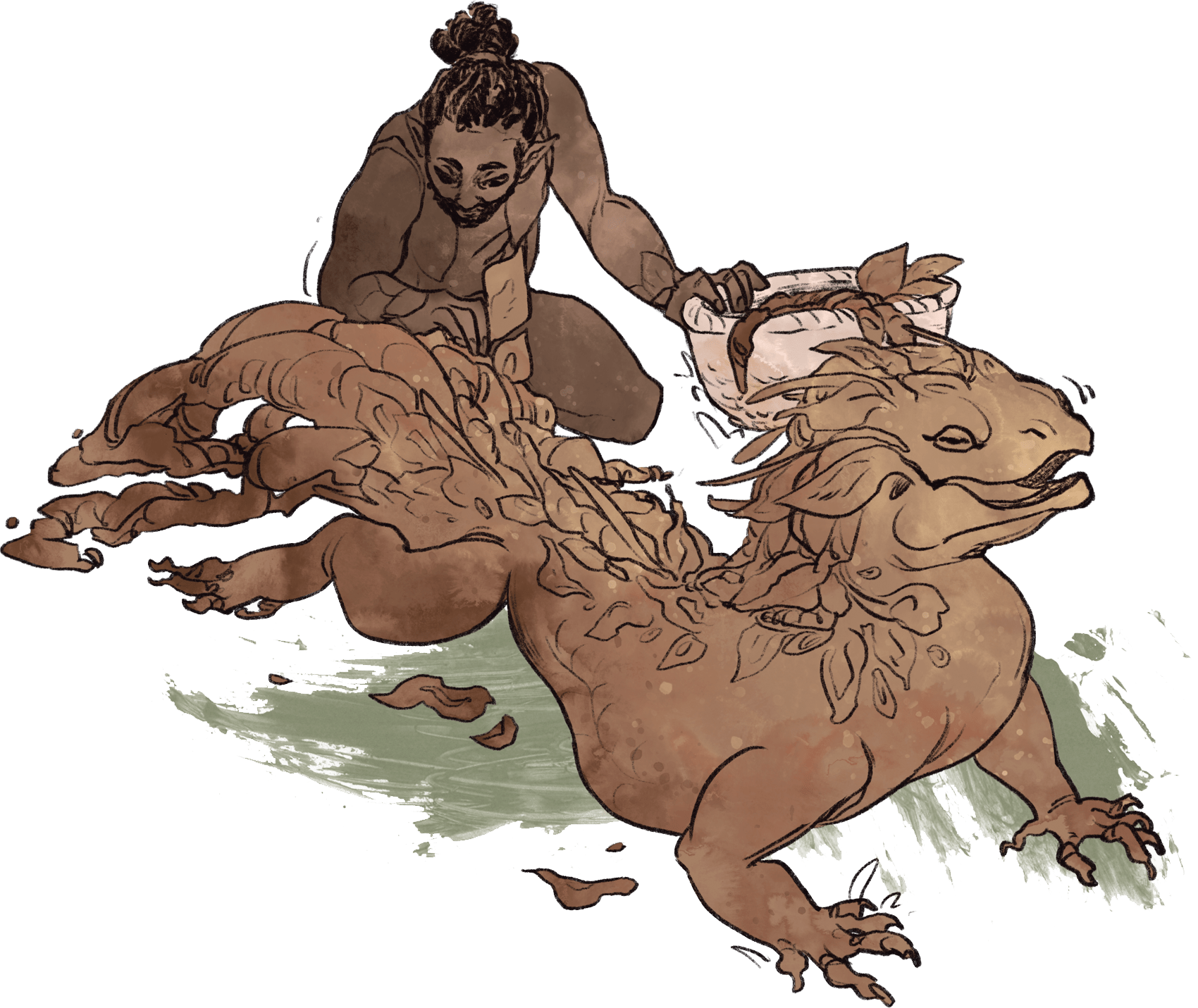
Domesticated amaranth dragons lack the natural stimuli that prompt them to shed their leaves, so humanoids must groom them attentively. Floral dragon grooming rakes are popular with people who keep these dragons. Amaranths require an exciting home environment with plenty of structures to climb and must be exercised at least once a day.
Caption
Fig. 2 An amaranth dragon lounges on a rock.
Amina
I coaxed the amaranth creature down from the tree with a bit of dried fruit from my rations. It snapped that up and licked my hand even when it could see that I had no more food.
I gently reached out and patted its head, and it closed its eyes, rubbing its snout against my hand. I think I have a new friend.
Personality Traits
Amaranth Dragon Personality Traits
| d8 | Trait |
|---|---|
| 1 | I can climb anything, and I prove it constantly. |
| 2 | I like to surprise and startle humanoids as a joke. |
| 3 | I always win games of hide and seek. |
| 4 | I have an affinity for playing fetch. |
| 5 | I have an especially keen sense of smell, which helps when I’m tracking, but I’m easily distracted if I smell a snack nearby. |
| 6 | Whenever I want attention, I shake my body, so my leaves rustle loudly. |
| 7 | I have boundless energy and can play all day without getting tired. |
| 8 | I lick people when I like them. |
Motivations
Amaranth Dragon Motivations
| d6 | Motivation |
|---|---|
| 1 | The world is big, and I want to see as much of it as I can with my humanoid companion. |
| 2 | I enjoy the company of humanoids, but I would love to meet more floral dragons. |
| 3 | Climbing every tree in my home territory is my dream. |
| 4 | I want to make as many new friends as I can. |
| 5 | I owe everything to the community of dragons that took care of me, and I will repay their kindness. |
| 6 | My humanoid companion tells me that I’m a good dragon. I want to live up to that expectation. |
Amina
After a few days at home with me, I noticed the leaves on the amaranth creature’s back had overgrown but weren’t falling off naturally, so I groomed it. It resembles a dragon in all ways except its floral features. Is it possible for flowers to become dragons or for dragons to become flowers? There is so much I don’t know about this floral dragon! But for now, it’s my friend, and its name is Rindath.
Adventure Hooks
Here are ways to include amaranth dragons in your game.
| d4 | Adventure Hook |
|---|---|
| 1 | Deforestation has displaced a large group of wild amaranth dragons. With nowhere to go, they have overrun a nearby humanoid settlement. |
| 2 | An adolescent amaranth dragon is stuck at the bottom of a tree. It is too young to climb by itself, and its mother is nowhere to be seen. |
| 3 | A rumor has spread about the last immortal amaranth dragon. Many hunters are looking for it to find out if the story is true. |
| 4 | A villager is putting up posters reading “LOST PET” and offering a reward for the return of Amie, their beloved amaranth dragon companion. |
Caption
Fig. 3 Grooming an amaranth dragon.