Ghostfire Gaming
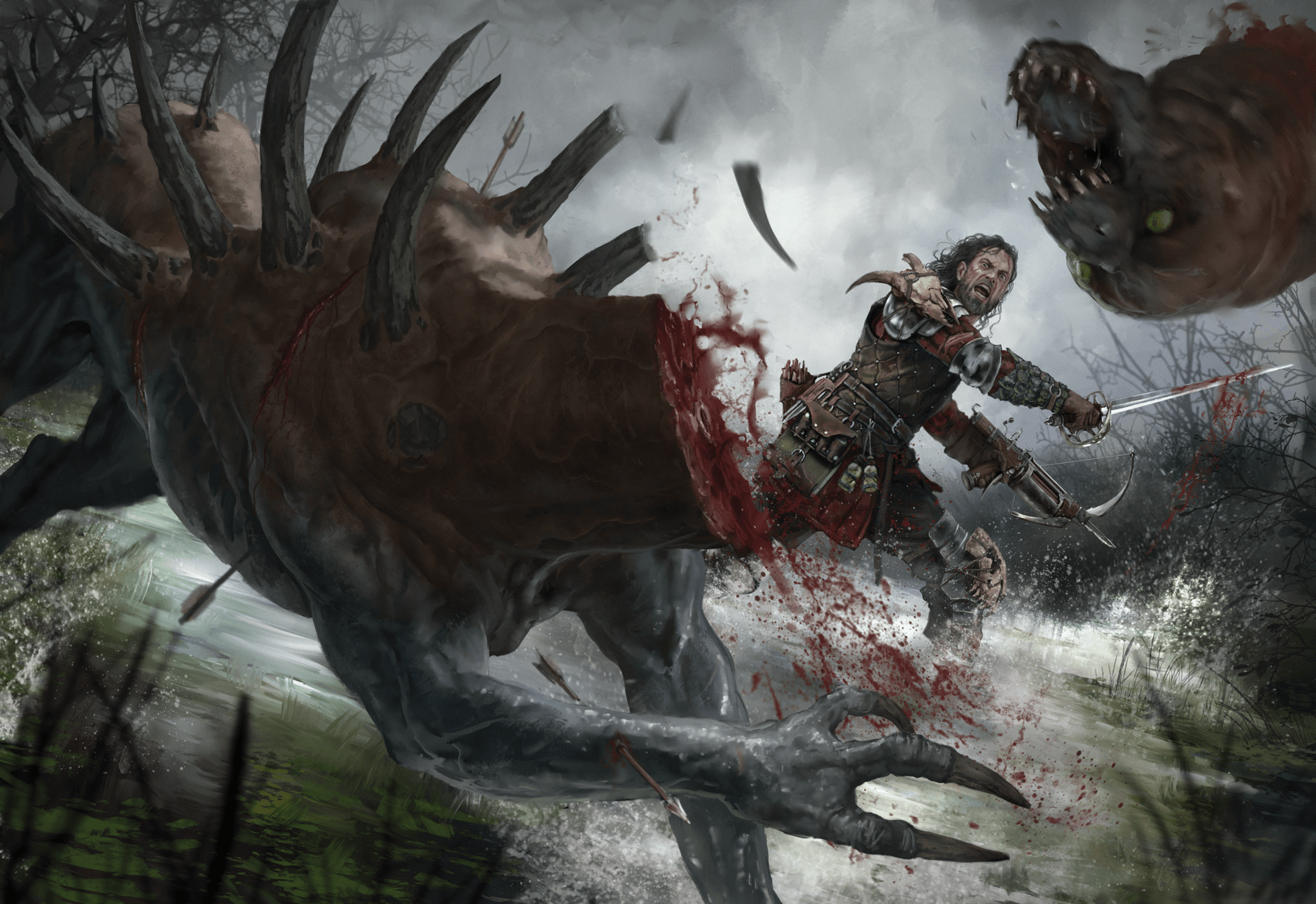
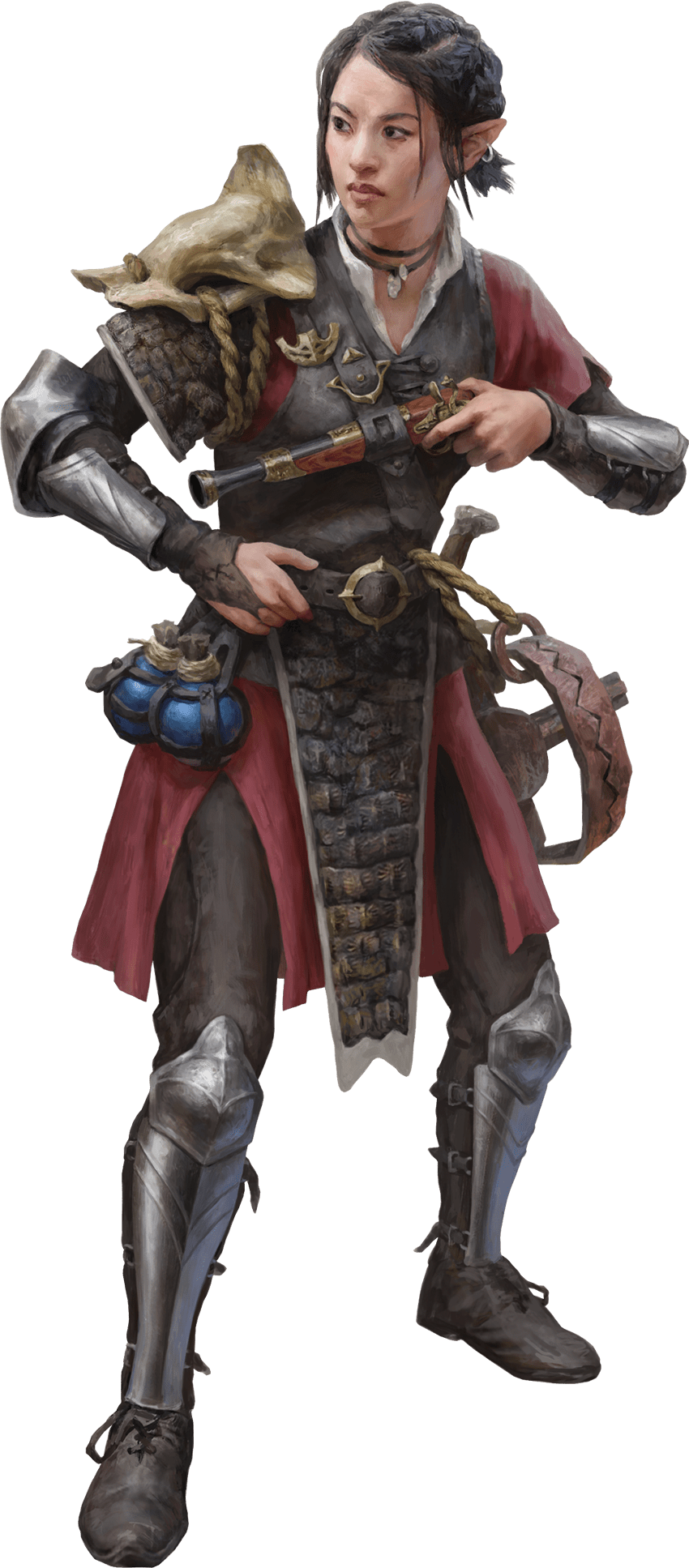
Monster Hunters are skilled professionals, specializing in identifying, tracking, and slaying monsters that threaten the lives and the livelihoods of the people of Etharis.
Each Monster Hunter trains in a different method for these tasks. Some hunters don heavy armor and carry shields to protect against crushing jaws and scything claws, others deploy cunning traps to keep a safe distance from the horrors they hunt, some assume the traits and powers of their enemies to better slay them, and others dabble in magic to supplement martial prowess with arcane wrath.
Core Monster Hunter Traits
| Primary Ability | Strength or Dexterity, Intelligence |
|---|---|
| Hit Point Die | D10 per Monster Hunter level |
| Saving Throw Proficiencies | Dexterity and Intelligence |
| Skill Proficiencies | Choose 3: Athletics, History, Investigation, Medicine, Nature, Perception, Religion, and Survival |
| Weapon Proficiencies | Simple and Martial weapons |
| Armor Training | Light and Medium armor and Shields |
| Starting Equipment | Choose A, B, or C: (A) Scale Mail, Longsword, Light Crossbow, 20 Bolts, Dungeoneer’s Pack, and 5 GP; (B) Studded Leather Armor, Scimitar, Shortsword, Longbow, 20 Arrows, Quiver, Dungeoneer’s Pack, and 10 GP; or (C) 160 GP |
Caption
Becoming a Monster Hunter
As a Level 1 Character
- Gain all the traits in the Core Monster Hunter Traits table.
- Gain the Monster Hunter’s level 1 features, which are listed in the Monster Hunter Features table.
As a Multiclass Character
- Gain the following traits from the Core Monster Hunter Traits table: Hit Point Die, proficiency with Martial weapons, and training with Light and Medium armor and Shields.
- Gain the Monster Hunter’s level 1 features, which are listed in the Monster Hunter Features table.
Caravan Guard
Vollendorf’s a fine place, no safer city this side of the empire. A word of advice though: if you’ve got a weak stomach, steer clear of the Bazaar.
Monster Hunter Class Features
As a Monster Hunter, you gain the following class features when you reach the specified Monster Hunter levels. These features are listed in the Monster Hunter Features table.
Monster Hunter Features
| Level | Proficiency Bonus | Class Features | Weapon Mastery |
|---|---|---|---|
| 1 | +2 | Monster Grimoire, Weapon Mastery | 2 |
| 2 | +2 | Fighting Style, Studied Response | 2 |
| 3 | +2 | Monster Hunter Subclass: Hunting Guild | 2 |
| 4 | +2 | Ability Score Improvement | 2 |
| 5 | +3 | Expert Strike | 3 |
| 6 | +3 | Improved Monster Grimoire | 3 |
| 7 | +3 | Hunting Guild feature | 3 |
| 8 | +3 | Ability Score Improvement | 3 |
| 9 | +4 | Knowledgeable Defense | 3 |
| 10 | +4 | Hunting Guild feature | 3 |
| 11 | +4 | Extra Attack | 4 |
| 12 | +4 | Ability Score Improvement | 4 |
| 13 | +5 | Improved Monster Grimoire | 4 |
| 14 | +5 | Lair Sense | 4 |
| 15 | +5 | Hunting Guild feature | 4 |
| 16 | +5 | Ability Score Improvement | 4 |
| 17 | +6 | Slayer’s Aid | 5 |
| 18 | +6 | Hunting Guild feature | 5 |
| 19 | +6 | Epic Boon | 5 |
| 20 | +6 | Grave Strike | 5 |
Level 1: Monster Grimoire
You create or inherit a repository of knowledge known as a Monster Grimoire. Each Monster Hunter carries a grimoire, a manual on dangerous creatures. A Monster Hunter’s grimoire is an object entirely unique to each hunter. It may be a leather tome recovered from a dusty library with notes made in the margins, a set of blood-stained scrolls inherited from a previous hunter, or a precious stone with a communing spirit held within.
If a Monster Hunter ever loses a grimoire, the hunter has retained enough knowledge to not suffer immediate drawbacks. However, the hunter can’t add to the grimoire until it is restored and therefore can’t take another Monster Hunter level until a lost grimoire has been replaced. A grimoire can be recreated by spending 8 hours and 50 GP worth of materials such as books, scrolls, and ink.
Choose two types of creatures that you are specialized in hunting from the following list: Aberrations, Beasts, Celestials, Constructs, Dragons, Elementals, Fey, Fiends, Giants, Monstrosities, Oozes, Plants, or Undead.
You add your Proficiency Bonus to Intelligence and Wisdom checks you make that relate to the creature types in your grimoire. For example, if Undead are in your grimoire, you add your Proficiency Bonus to an Intelligence (History) check to recall lore about an Undead creature you’re investigating or a Wisdom (Medicine) check to identify claw marks left on a corpse by an Undead creature. If you are already proficient in a skill when asked to make an Intelligence or Wisdom ability check relating to the monster types in your grimoire, you add double your Proficiency Bonus instead.
When you gain this feature, you also learn one language based on the chart below. (You can add languages to this chart based on your own campaign world.)
Monster Type Language
| Monster Type | Languages |
|---|---|
| Aberration | Deep Speech or Undercommon |
| Beast | Sylvan |
| Celestial | Celestial |
| Construct | Draconic |
| Dragon | Draconic |
| Elemental | Primordial |
| Fey | Sylvan |
| Fiend | Abyssal or Infernal |
| Giant | Giant |
| Monstrosity | Deep Speech |
| Ooze | Deep Speech or Undercommon |
| Plant | Sylvan |
| Undead | Abyssal or Infernal |
Level 1: Weapon Mastery
Your training with weapons allows you to use the mastery properties of two kinds of weapons of your choice with which you have proficiency, such as Longbows and Longswords. Whenever you finish a Long Rest, you can practice weapon drills and change one of those weapon choices.
When you reach certain Monster Hunter levels, you gain the ability to use the mastery properties of more kinds of weapons, as shown in the Weapon Mastery column of the Monster Hunter Features table.
Level 2: Fighting Style
You gain a Fighting Style feat of your choice.
Level 2: Studied Response
You have learned the most effective way to slay a monster is to strike its most vulnerable area at the right moment. Too early, and your attack glances away. Too late, and the monster may eviscerate you.
When a creature you can see within 60 feet of you targets you or another creature with a melee or ranged attack, you can take a Reaction before the attack roll to make one attack with a weapon or an Unarmed Strike against that creature.
If the attack misses, you regain the use of your Reaction.
Level 3: Monster Hunter Subclass: Hunting Guild
You gain a Monster Hunter subclass of your choice. A subclass is a specialization that grants you features at certain Monster Hunter levels. The guild you choose grants you features when you reach Monster Hunter levels 3, 7, 10, 15, and 18.
Level 4: Ability Score Improvement
You gain the Ability Score Improvement feat or another feat of your choice for which you qualify. You gain this feature again at Monster Hunter levels 8, 12, and 16.
Level 5: Expert Strike
You learn the weaknesses of monsters so that you know exactly where to strike to inflict the most damage. You can add your Intelligence modifier to the attack and damage rolls of your weapons and Unarmed Strikes.
Level 6: Improved Monster Grimoire
You have expanded your Monster Grimoire with your experience and knowledge.
You can select a third creature type to add to your Monster Grimoire from the following list: Aberrations, Beasts, Celestials, Constructs, Dragons, Elementals, Fey, Fiends, Giants, Monstrosities, Oozes, Plants, or Undead. You can’t choose a creature type you have chosen before. All the benefits you gain from your Monster Grimoire now also apply to this new type.
Additionally, your attack rolls with weapons and Unarmed Strikes against creature types in your Monster Grimoire can score a Critical Hit on a roll of 19 or 20 on the d20.
Level 9: Knowledgeable Defense
You can rely on your knowledge to anticipate a monster’s actions and summon your best defense.
Whenever a creature type in your Monster Grimoire forces you to make a saving throw, you can make an Intelligence saving throw in place of that saving throw instead.
Level 11: Extra Attack
You can attack twice instead of once whenever you take the Attack action on your turn.
Level 13: Improved Monster Grimoire
Your Monster Grimoire is further expanded by your encounters and studies.
You can select a fourth creature type to add to your Monster Grimoire from the following list: Aberrations, Beasts, Constructs, Celestials, Dragons, Elementals, Fey, Fiends, Giants, Monstrosities, Oozes, Plants, or Undead. You can’t choose a monster type you have chosen before. All the benefits you gain from your Monster Grimoire now also apply to this new monster type.
Level 14: Lair Sense
You are experienced at navigating the threats that arise near a monster’s lair. You have Advantage on saving throws and Resistance to the damage of lair actions and regional effects caused by creatures. In addition, you have Advantage on saving throws and Resistance to damage against the Legendary Actions of creature types in your Monster Grimoire.
Level 17: Slayer’s Aid
You’re able to coordinate with your allies to quickly slay dangerous monsters.
When you use Studied Response, choose a Friendly creature that can see or hear you. That creature can use its Reaction to make one attack with a weapon or Unarmed Strike against the creature that triggered your Studied Response. If the ally does not have their Reaction, they regain it but then must use it to make the attack. Your ally’s attack occurs after yours but before the target creature rolls its own attack. This ability refreshes at the start of your turn.
Level 19: Epic Boon
You gain an Epic Boon feat or another feat of your choice for which you qualify.
Level 20: Grave Strike
You gain the ability to strike mortal blows against the creatures you have studied.
Your attack rolls with weapons and Unarmed Strikes against creature types in your Monster Grimoire can now score a Critical Hit on a roll of 18 through 20 on the d20.
When you score a Critical Hit against a creature type in your Monster Grimoire, the creature must make a Constitution saving throw. The DC equals the damage taken, up to a maximum DC of 30. On a failed save, the creature drops to 0 Hit Points. On a successful save, the creature takes the attack’s normal damage.
You can use this feature a number of times equal to your Intelligence modifier (minimum of once), and you regain all expended uses when you finish a Long Rest.
Monster Hunter Guilds
A Monster Hunter subclass is a specialization that grants you features at certain Monster Hunter levels, as specified in the subclass.
Hunting guilds are groups of Monster Hunters who use the same teachings and techniques. Some guilds are formally organised like a mercenary company, while others are more loosely organized but have inherited similar knowledge.
| Name | Source | Publisher | Edition |
|---|---|---|---|
| Carver Guild | Grim Hollow: Player’s Guide | Ghostfire Gaming | 5.5e |
| Devourer Guild | Grim Hollow: Player’s Guide | Ghostfire Gaming | 5.5e |
| Occultist Guild | Grim Hollow: Player’s Guide | Ghostfire Gaming | 5.5e |
| Trapper Guild | Grim Hollow: Player’s Guide | Ghostfire Gaming | 5.5e |