Hit Point Press
Kaltaar
Azalea dragons are intelligent hunters.
Fangs of the Wolf Tree
Legends tell of an ancient floral dragon, overgrown and gnarled with age, known as Haskra the Wolf Tree. For centuries, she protected the land and creatures she ruled over with her might. She was revered as a god by the creatures of the wood, but the humanoid kingdoms feared her power and coveted her land. Eventually, these kingdoms banded together under two powerful monarchs, one human and one elvish, who launched a campaign to claim the land she stewarded. It took a year and a day for the battered humanoid armies to finally quell Haskra. With her dying howl, she bloomed with great reddish-pink flowers that soaked up the blood of the fallen. These flowers grew into the first azalea dragons, agents of their mother’s revenge upon humanoids who think themselves lords of wild places.
Physiology
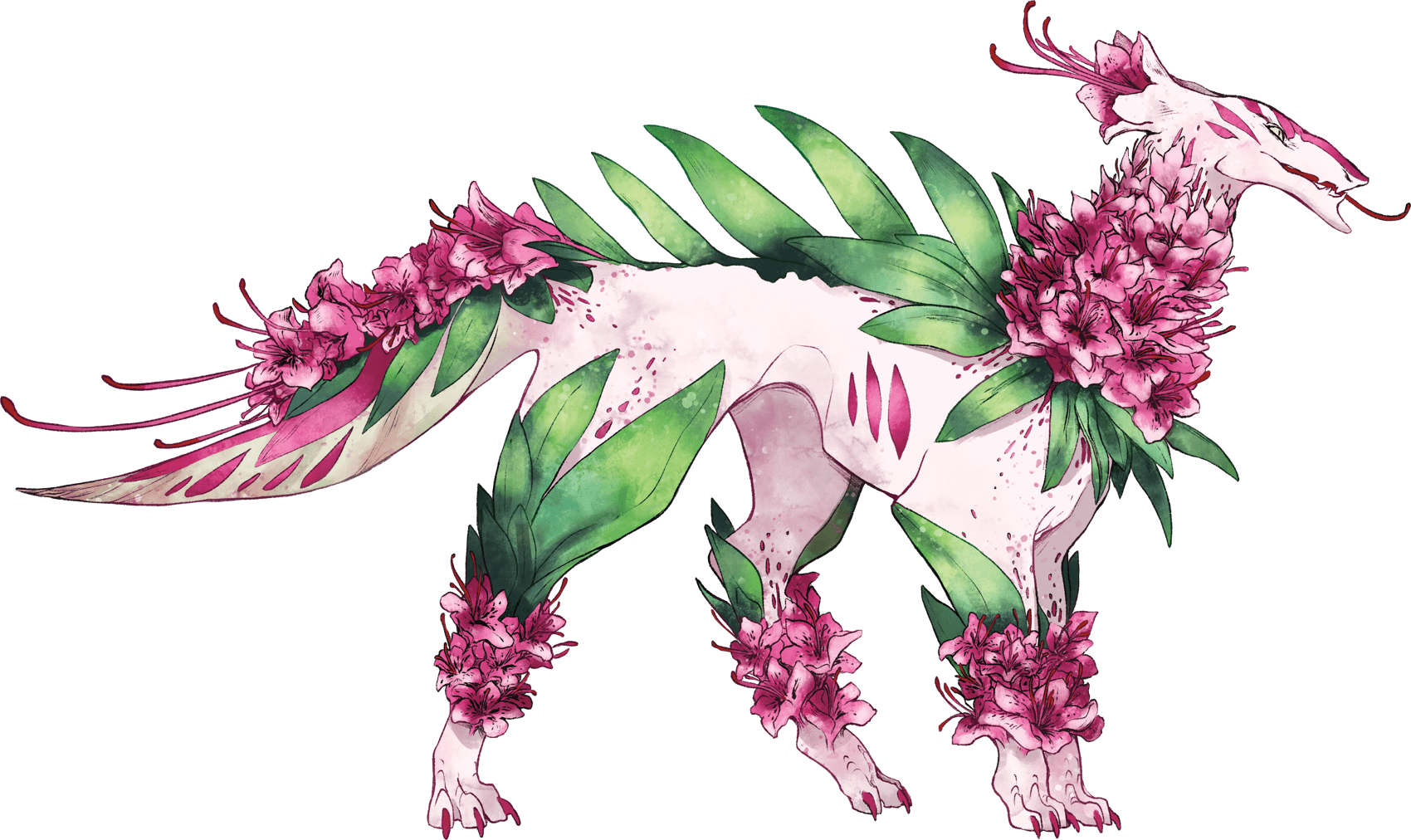
Intelligent hunters, azalea dragons have a form equal parts lupine and draconic. They bloom pink, purple, red, or maroon flowers around the neck, the base of the tail, the ears, and the ankles. Long green leaves sprout around these flowers, forming a collar around their necks and spines along their backs. Though they resemble wolves, azalea dragons are as intelligent as humanoids. They communicate with each other in their own dialect of Draconic, and some even learn to speak humanoid languages.
When fully grown, an azalea dragon is the size of a large wolf, measuring around 5 feet from nose to tail and standing roughly 3 feet at the shoulder. Azalea dragons reach adulthood roughly two years after hatching. It is not known how long azalea dragons can live, though most adults sighted are estimated to be between 30 and 50 years old.
Azalea dragons are built for hunting. Besides their rows of sharp teeth, they have extraordinary senses of smell and hearing, which are supplemented by temperature-sensitive organs behind their nostrils that allow them to sense the body heat of their prey. Azalea dragons have long, slender legs that enable them to travel swiftly over great distances. Their tails resemble broad leaves and help them maintain their balance when they travel at speed. Though carnivorous, azalea dragons supplement their diet with berries, edible plants, and honey.
Kaltaar
Unexpectedly, I have been accepted by the pack of azalea dragons who once shadowed me. Perhaps my draconic features inspired their curiosity. Whatever the reason, they have allowed me rare glimpses into their society.
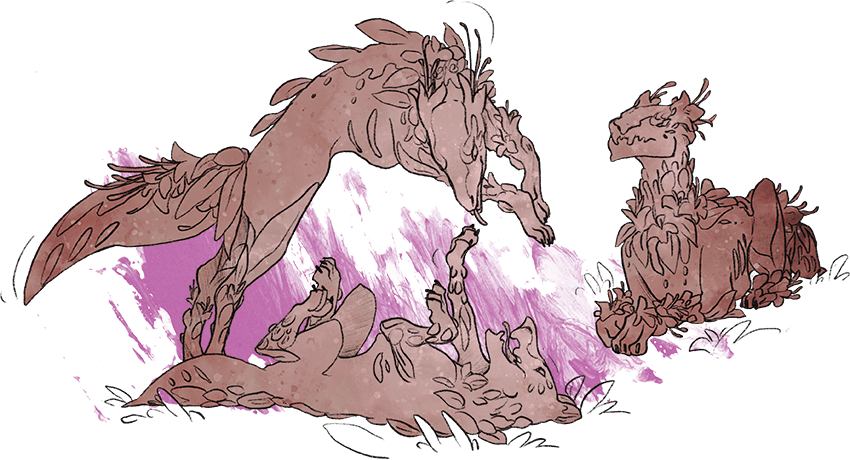
Contrary to their fearsome reputation, azalea dragons are devoted parents. Each member of the pack helps to raise wyrmlings to adulthood, and they play much like the rhododendron dragons we witnessed in Aneondel…those were happier times.
Caption
Fig. 1 An adult azalea dragon watches over two wyrmlings at play.
Habitat
Azalea dragons prefer to live in grasslands and forests in warm climates with mild or short winters. Though they can survive the cold, when enduring low temperatures, their flowers drop off, weakening the dragons until their flowers bloom once more in the spring. Any area azalea dragons claim as their territory must be large enough to support a variety of large prey to feed the pack. Areas populated by aurochs, antelope, elk, and moose are ideal. Forests full of birds and rodents are also prized by packs, as smaller prey can support them in leaner months.
Azalea dragons’ territories are patrolled and protected by one or more packs. The packs set well-defined borders that snake around humanoid settlements and the territories of other species of dragon. Within these territories, they make warm and comfortable dens in caves, meadows, or thickets. Sometimes, azalea dragons share their territories with other floral dragons, especially gentle varieties such as dandelion dragons or jade vine dragons.
Packs tend to form alliances with intelligent dragons in order to share the land, though they avoid territories occupied by more dangerous creatures such as wisteria dragons. While they prefer to avoid conflict with other dragons, azalea dragons will attempt to drive out another dragon if it represents a threat to their pack.
Unlike their thoughtful interactions with other floral dragons, Azalea dragons approach rhododendron dragons with instant hostility. Once the same species, azalea dragons see rhododendron dragons as traitors who went against the will of the Wolf Tree by allying with humanoids. Generally, azalea dragons prefer to live far from humanoids and menace settlements that encroach on their territory, hunting humanoids who stray into their lands as though they were any other prey.
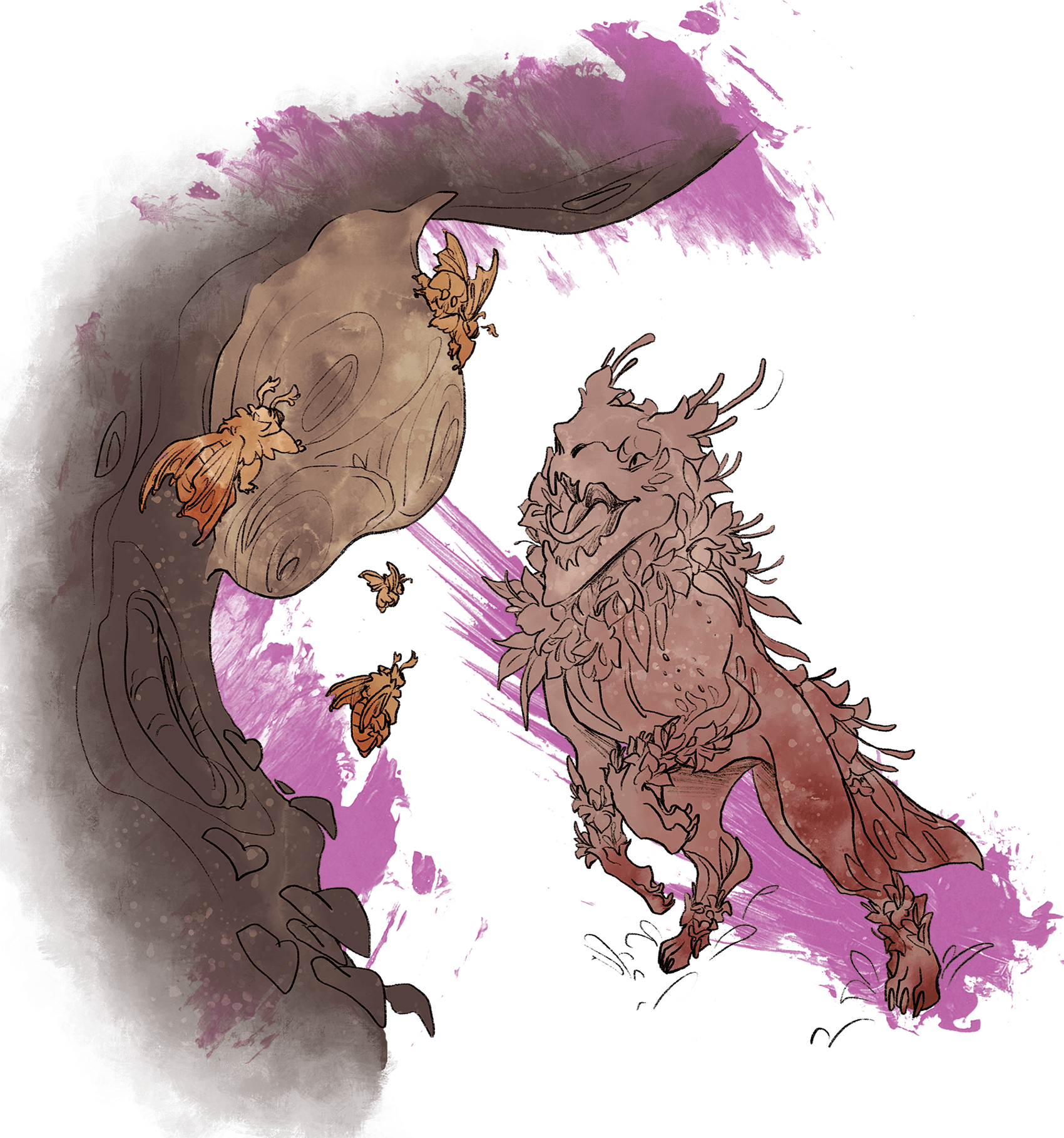
Azalea dragons love honey, especially the honey produced by vespons—tiny, bee-like creatures often found in the company of floral dragons. Azalea dragons rely on pollinators like vespons to keep their flowers and bodies healthy. The nectar collected from azalea dragon’s flowers produces a toxic honey, which can cause hallucinations and sickness in humanoids when consumed. This honey is the favorite of azalea dragons, who are immune to its effects. Alchemists value this honey as an ingredient for serums and painkillers, but any who harvest it are cautious, for they know that azalea dragons prowl where such honey is found.
Caption
Fig. 2 An azalea dragon barks to signal the discovery of a vespon hive.
Kaltaar
Azalea dragons can smell honey from miles away, amplifying their ability to track the flight patterns of vespons. I believe this pack led me to the honey I needed to treat Zethandriel’s wounds.
It’s fortunate Zethandriel’s rhododendron dragon companion Ardral would not leave their side to join me on this errand, as I doubt the azalea pack would have been so generous were I traveling with one of their ancestral enemies.
Behavior
Social creatures, azalea dragons live in packs led by an adult pair who are bonded for life and who hatched many of the pack members. From time to time, a lone azalea dragon or a smaller faction ousted from another pack will join an already-established pack. Packs function as extended family units with complex social hierarchies. Each pack has its own strong tradition of laws, ethics, and morals. Members are expected to help the group by performing duties, such as hunting, foraging, educating wyrmlings, patrolling the borders, alerting the pack to danger, or fending off rivals. Azalea dragons find mates within allied packs living nearby, and permanent migration between packs is common during the mating season. Wyrmlings are raised by the whole pack from the moment they hatch. With all pack members acting as co-parents, the pair that produced the eggs has time to rest and to continue to fulfill their other duties.
Caption
Fig. 3 An azalea dragon snarls to
warn away trespassers.
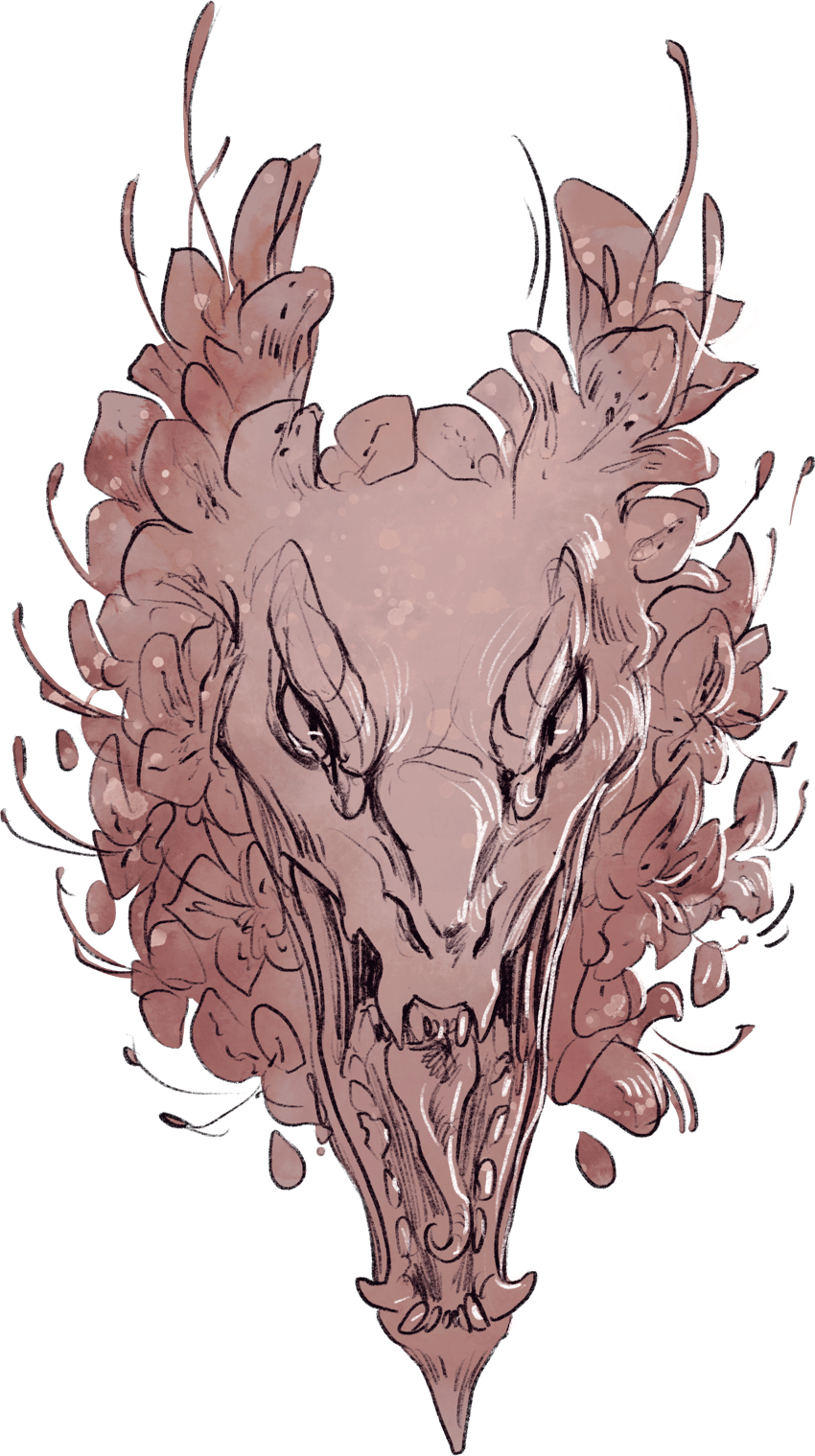
Occasionally a pack splits, with some members leaving to form a new pack elsewhere. This can be in response to the pack becoming too numerous, making prey scarce. In such cases, the split is amicable, and the two packs may maintain cultural ties despite living apart. In other cases, a split can arise from a disagreement or a feud, and the weaker faction is driven out, creating a rivalry that can persist for generations.
Azalea dragons prefer to hunt using numbers, stamina, and coordinated tactics. They are persistent trackers and are able to chase prey to the point of exhaustion over great distances. Though they will hunt humanoids, azalea dragons don’t consider humanoids suitable as food. Rather, they see them as destructive pests who bring ruin and famine and hunt them as a matter of pack protection and ancient enmity.
All azalea dragons are taught by their packs the tale of how humanoids murdered their god and progenitor, Haskra the Wolf Tree. They still carry Haskra’s grudge, especially against humans and elves. Very rarely, a pack will come to respect druids who fully reject humanoid society in favor of living in harmony with nature. Even more rarely, a few dragon packs have broken the ancient taboo and made friends with these druids. Most azalea dragon packs have enacted laws to let humanoid druids live, so long as they do not work against them and respect the pack’s right to their territory.
Personality Traits
Azalea Dragon Personality Traits
| d8 | Trait |
|---|---|
| 1 | My loyalty to my pack is unwavering and absolute. |
| 2 | I’m curious about the world beyond my territory. |
| 3 | The sound of music soothes my wild heart. |
| 4 | I’m cold, cunning, and ruthless. |
| 5 | I am proud, distant, and aloof. |
| 6 | Once I make a friend, I trust them as if they were one of my pack. |
| 7 | I’ve been burned before and am slow to trust others. |
| 8 | I bite first and ask questions later. |
Motivations
Azalea Dragon Motivations
| d6 | Motivation |
|---|---|
| 1 | My pack was ousted by rival azalea dragons. I am scouting ahead to find us a new territory to call home. |
| 2 | A humanoid settlement threatens my forest and my pack. I must do what I can to protect them both. |
| 3 | My pack was killed, and I alone survived. I’d do anything to avenge them. |
| 4 | I seek medicine to heal my wounded pack leader. |
| 5 | I have fallen in love with a rhododendron dragon, but we must keep our love a secret from my pack. |
| 6 | A famine has made me and my pack ravenous and desperate for food. |
Adventure Hooks
Here are ways to include azalea dragons in your game.
| d4 | Adventure Hook |
|---|---|
| 1 | After one of their wyrmlings was captured by poachers, a pack of azalea dragons has begun hunting any humanoids who travel through their territory. |
| 2 | A desperate azalea dragon pack has made a city an offer to parley. In exchange, they request the city’s help with the fungal plague that is ravaging their population. |
| 3 | A pack of azalea dragons has allied with a manchineel dragon, and they are plotting against a local city. |
| 4 | The secret that will lead the party to a person, place, or thing they must find is rumored to be known only by an ancient azalea dragon who lives with her pack deep in the wild woods. |
Kaltaar
I heard snarling and rushed to see an azalea dragon baring its fangs at a humanoid trespasser. I barely recognized the figure, worn nearly to a shadow, but I’m sure it was my old friend Izora. The azalea dragon’s snarls gave way to yelps as she fired off a bolt of magic.
Izora’s spell would have killed it if I hadn’t intervened. We shared a glance but Izora fled before I could speak with her. I warned the dragon not to follow. If a wisteria dragon could not kill Izora, the azalea dragon stood no chance.